


Development & evidence
Proposed first development programme · £300,000
The programme turns a technical study into measured product capability. It is not a short peak-power demonstration: it is evidence that the installed system can serve circuits, schools and experiences repeatedly.
Every technical value carries a status. A measured result is not automatically verified or released for publication. Today all vehicle figures are study values; public evidence requires verification and explicit public release.
Proposed programme outputs
- Sprint 25E integration
- Rear-drive interfaces, torque response, drive and neutral behaviour, and calibrated discovery and learning configurations.
- Sprint 66E integration
- Twin rear-drive installation, mechanical and suspension interfaces, independent torque control and measured dynamic behaviour.
- Thermal repeatability
- Temperatures, power-limiting, hot restart and recovery across drives, electronics, buffer, modules, harnesses and connectors.
- Prototype energy system
- Safe retention and manual exchange, off-board charging, monitoring and validated charging and swap architecture.
- Compliance evidence
- Configuration records, protection and fault response, documentation and integration tests for a later vehicle-approval application.
- Operator release information
- Measured energy per run, permitted sessions, charging and recovery conditions, maintenance checks and capacity limits.
Study specification
| Input | Sprint 25E | Sprint 66E | Status |
|---|---|---|---|
| Vehicle mass budget | 495 kg | 514 kg | STUDYConstructed budget, not weighed vehicles |
| Peak traction power | 25 kW | 66 kW | STUDYInstalled thermal capability to validate |
| Rear-wheel torque envelope | 1,800 Nm | 1,080 Nm | STUDYBefore tyre, control and thermal limits |
| Drive-unit mass basis | 41 kg | 2 × 30 kg | STUDYIntegration-study inputs |
| Removable energy modules | 2 × 4.9 kWh gross | 2 × 4.9 kWh gross | STUDYTarget 15 kg each; useful energy to verify |
| Separate 48V power buffer | Separate from removable modules | Separate from removable modules | STUDYPower, usable energy and cooling to specify |
| 0-60 mph estimate (vehicle only / with 80 kg driver) | 9.8 s / 11.3 s | 4.4 s / 5.1 s | STUDYPublished analytical estimate, not a test |
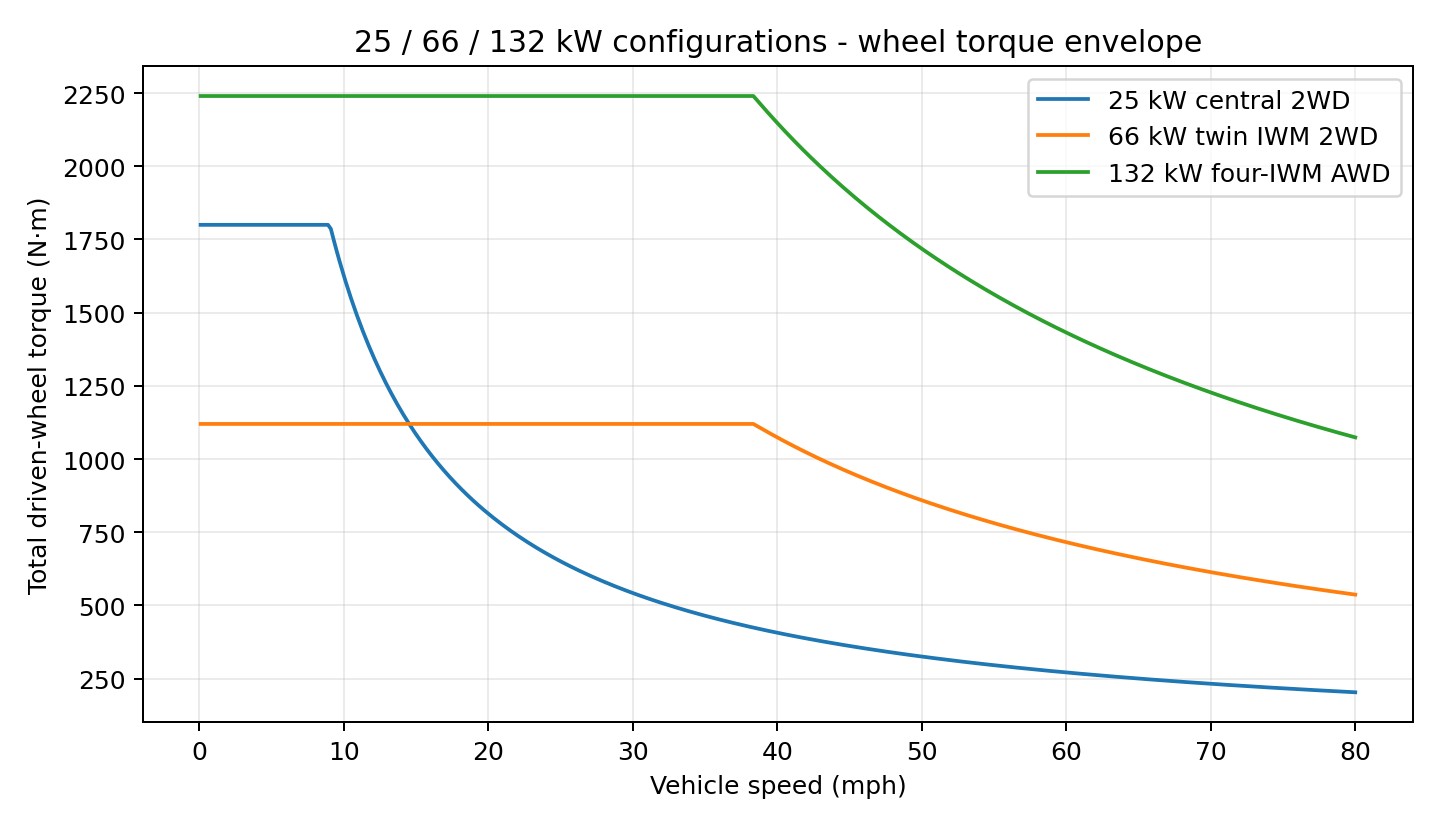
Ideal drive envelopes before tyre adhesion, axle loading and thermal derating. STUDY.
Torque where it matters
Sprint 25E provides strong initial torque and reaches its power-limited region early. Sprint 66E maintains a broad useful torque region into medium speeds. A real multi-ratio torque map replaces the simplified envelope during integration.
Funding stages
Two releases
STAGE 1
£150,000 cumulative
Eligible receipts release Sprint 25E and common-system work.
STAGE 2
£300,000 cumulative
A further £150,000 releases Sprint 66E and the remaining work.
| Workstream | Stage 1 | Stage 2 | Total |
|---|---|---|---|
| Common architecture | £30,000 | £15,000 | £45,000 |
| Sprint 25E demonstrator | £45,000 | £0 | £45,000 |
| Sprint 66E demonstrator | £0 | £65,000 | £65,000 |
| Energy / prototype station | £30,000 | £20,000 | £50,000 |
| Thermal engineering | £25,000 | £20,000 | £45,000 |
| Other validation | £5,000 | £15,000 | £20,000 |
| Coordination / reserve | £15,000 | £15,000 | £30,000 |
| Total | £150,000 | £150,000 | £300,000 |
Planning allocations from the controlled programme document; supplier and MK quotations refine the detail. PROPOSED.
Prototype energy development belongs to this validation budget. Deployed customer-network assets and future qualifying energy sit in a separate proposed VDK adoption-support plan; the same hardware or energy cost is not counted twice.
Thermal and compliance validation
The proposed campaign tests sustained installation behaviour, not just peak output. Component specifications and validated installation conditions set temperature limits; no temperature threshold is invented.
- Instrumented single runs
- Each vehicle, tyre, setup, driver mass and charge state: record power, torque, temperatures, energy and end-of-run condition.
- Morning and afternoon repetition
- Ten runs, a real lunch recovery, then ten more from credible hot-start conditions: record accumulation, derating, ready-module inventory and next-run eligibility.
- Hot restart and low charge
- Delayed pits, warm modules and low permitted charge: test protection, torque restrictions and return-to-service criteria.
- Sprint 66E wheel-area duty
- Braking heat, unequal rear demand, rough surfaces and kerbs: measure branch temperatures and drive/brake interaction.
- Charging and degraded operation
- Multiple channels, ventilation and interrupted supply; sensor, connector, drive and buffer faults: record detection, disable, recovery and inventory effects.
- Repeated handling and exchange
- Retention, connectors, interlocks and human operation: verify safe procedures, measured swap time, wear and maintenance needs.
Sprint 66E teaching concepts · development functions
Grip, electronic limited-slip differential, rotation, oversteer introduction, drift assistance and wet simulation explore different rear-torque and slip strategies under supervision. They are not released autonomous safety capabilities. Tyres, torque, instructor intervention and wear must be validated together.
Indicative sequence · not delivery dates
01
Architecture and interfaces
Months 0-2
02
Sprint 25E and common energy / thermal work
Months 2-5, after Stage 1 release
03
Sprint 66E integration
Months 3-7, after Stage 2 release
04
Repeated duty, evidence and approval preparation
Months 5-12
These overlapping planning windows depend on funding, supply and test readiness. Vehicle configuration and approval responsibilities need agreement with MK; successful testing alone is not homologation.
Thermal repeatability
What each installation sustains across a full day: temperatures, power-limiting, hot restart and recovery over repeated sessions.
10 + 10 duty target TARGET
Ten morning and ten afternoon runs per car, about ten minutes each, in 15-minute dispatch slots.
Compliance preparation
VDK prepares electric-system evidence for the later vehicle-approval application. A successful track session is not homologation.
Evidence publication
Measured values are published separately from study targets and replace the corresponding input rather than being blended in. Each released result needs its vehicle configuration, date and operating limits. Successful and aborted runs are recorded; thermal interruptions are not silently averaged away. See the current state on the Momentum page.